
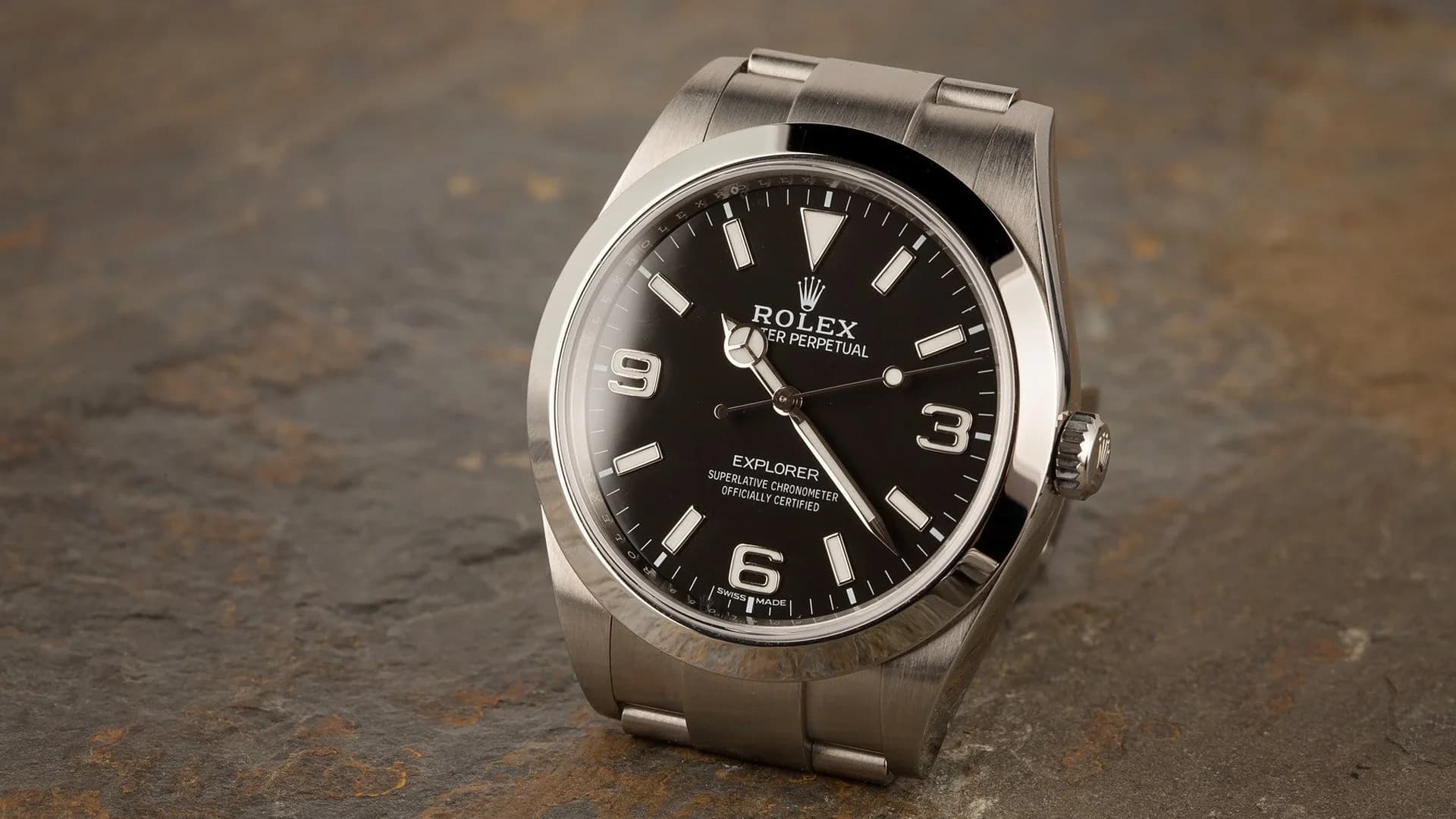
The legendary Rolex Explorer watch is well-known for its timeless style and tough dependability. The Rolex Explorer, which is well-known for its connection to exploration and adventure, has evolved into a representation of toughness and practicality by skilfully fusing form and function. It is especially admired for its straightforward yet sturdy design, which makes it a favourite among both collectors and watch lovers.
Rolex Explorer: A Legacy of Endurance, Heritage, and Timeless Design
History and Legacy of the Rolex Explorer
In 1953, the Rolex Explorer was unveiled to honour Sir Edmund Hillary and Tenzing Norgay's successful ascent of Mount Everest. During their historic expedition, both climbers wore Rolex timepieces. The Rolex Explorer's reputation as a sturdy and dependable watch that can resist the most challenging circumstances was cemented by this connection to one of the greatest exploration achievements. The Rolex Explorer Reference 6350, the first officially labelled Rolex Explorer, quickly replaced the original Rolex Explorer model, the Reference 6150. This model had a unique black dial with luminous hands and large hour markings that made it easy to read in low light. With its sturdy case and dependable movement, the Rolex Explorer was especially designed to satisfy the demands of adventurers and explorers.
The Rolex Explorer has undergone numerous revisions and modifications throughout the years, all of which have improved its functionality while preserving its timeless design. The Rolex Explorer Reference 1016, which had a better mechanism and a more elegant design, was first released in the 1960s. Owing to its sturdy build and subtle elegance, this model became a symbol of its time. Alongside the addition of a new movement, the Calibre 3130, Rolex's Reference 14270 in 2001 represented a major improvement. While maintaining the Explorer's iconic appearance, this Rolex Explorer also included a bigger case size and revised design components.
The Rolex Explorer Today (Specifications and Market Value)
Considering its lengthy history, the Explorer stays astonishingly true to its initial simple design and refreshingly restrained today. The contemporary references, 124270 (36mm) and 224270 (40mm), are still made of oystersteel and share many characteristics with their predecessors, including a clean black or white dial, the iconic 3-6-9 configuration, and a time-only, no-date display. The internal calibre 3230, which offers a 70-hour power reserve, improved shock resistance, and Rolex's exclusive Chronergy escapement, powers both. Dial luminosity has been one of the Explorer's more important recent upgrades. The patented Chromalight lume, which offers a cooler tone and a longer-lasting glow in low light, has taken the place of earlier tritium and radium compositions.
The Explorer is still one of the more affordable professional Rolex models available at retail. The 36mm model is currently priced at AED 29,800 in the UAE; secondary market listings are slightly less than retail, indicating a good supply and controlled demand. At AED 52,500, the two-tone Rolesor 36mm is the priciest Explorer available. Even if older models like the 1016 and 114270 have gained sizable fan bases, the Explorer is still one of Rolex's most reliable models—a reliable choice for people who value functionality over flash.
Rolex Explorer Popularity
Mountaineers continue to favour the Rolex Explorer. The Rolex Explorer is linked to the renowned mountaineer and adventurer Reinhold Messner. He is renowned for his multiple climbs of the highest peaks in the world, including Mount Everest, without the need for additional oxygen. His recommendation highlights the watch's robustness and appropriateness for harsh environments. Another well-known mountaineer, Ed Viesturs, also sports a Rolex Explorer. Viesturs has ascended all 14 of the 8,000-meter summits in the world. His connection to the watch emphasises how dependable and effective it is under difficult situations. Don Draper from the television show Mad Men also wore the Rolex Explorer. This deliberate decision highlights the Rolex Explorer's classic elegance and association with mid-20th-century fashion and culture.
Notable Examples of the Rolex Explorer
1. Rolex Explorer Reference 6350 (1953) – The First “Explorer” Model
The 6350, which was released in the months after the Everest summit, is regarded by many as the first authentic Rolex Explorer, the model that officially combined name and function. Its self-winding movement and thin 36mm steel case make it look like the early Oyster Perpetuals of the 1950s. A unusual gilded honeycomb face and huge radium-painted numerals, some of which have weathered to a warm orange patina, are features of several 6350 vintage grail watches. One of the most sought-after characteristics in vintage Rolex collecting is the "pumpkin" effect, as collectors call it. At a Sotheby's auction in December 2023, a unique honeycomb Explorer ref. 6350 brought in $48,260.
2. Rolex Explorer Reference 1016 (1963–1989) – The Adventurer’s Watch
The 1016 is regarded by many as the ultimate Rolex Explorer. It is still one of the most enduring references in Rolex history, having been produced for more than 25 years with few modifications. Its straightforward, self-assured design never required reimagining. This reference solidified the Explorer's standing as a tool for actual trips with its enhanced dial and revised internal calibre. During the 1980s SANAE Antarctic trip, one noteworthy specimen was lent to South African Explorer Graham Blyth, who used it to withstand temperatures below –50°C while maintaining accurate timekeeping. Author Ian Fleming, who himself wore a 1016, described Bond's watch as a "heavy Rolex Oyster Perpetual" with luminous numbers, which is commonly taken as a reference to the Explorer.
3. Rolex Explorer II Reference 1655 (1971) – The “Steve McQueen” Explorer
The Explorer II, a speciality watch designed for darkness rather than altitude, was introduced in 1971 and was Rolex's first significant divergence from the original Explorer line. In order to aid cave and arctic explorers in differentiating between day and night, the reference 1655 had a bright orange hand and a fixed 24-hour bezel. The watch was a slow seller at first because of its crowded matte dial, dense minute track, and arrow-shaped "Freccione" hand, which set it different from every other Rolex of the time. However, it has become a cult favourite among antique collectors over time. A long-standing marketing blunder is partially responsible for its mythology: An Italian magazine from the 1970s stated that actor Steve McQueen wore the watch, even though there was no proof to back up this claim (McQueen famously wore a Submariner). Nevertheless, the moniker endured, and the mythology expanded. The 1655 is currently the most sought-after vintage Explorer, with well-preserved models selling for more than AED 200,000 on the secondary market.
One of a Kind
One of Rolex's purest and most purpose-driven designs, the Explorer was created to commemorate humanity's victory over the extremes of nature. It endures because it doesn't follow trends or dazzle with complexity. The Explorer is still one of the most affordable models in the Rolex lineup, costing around the same as the Oystersteel Datejust, even if some historical watches, especially those associated with early expeditions or uncommon dial variations, have become sought-after collector's items. After more than 70 years, it serves as a reminder that function always wins out over flair in both watchmaking and mountaineering.
Similar Blogs
Discover more stories and insights from our collection of exclusive articles.


